
Key Takeaways
- A referral program's effectiveness depends not only on generating introductions but also on how consistently firms manage the follow-through.
- Operational friction, including manual data preparation and inconsistent follow-up processes, can create challenges after a referral is received.
- Measuring a referral program by counting introductions is insufficient. Engagement quality indicators, like the Referral-to-Client Conversion Rate and referral lag time, provide deeper insight.
- Referrals from COIs and existing clients may involve different prospect circumstances and preparation needs, making flexibility important within a repeatable acquisition workflow.
- A structured referral program can benefit from defined processes for intake, follow-up, and, when appropriate, portfolio analysis and presentation.
This article focuses on an important distinction within a financial advisor referral program : generating introductions is one part of the process, and managing what happens after those introductions are received is another. Firms may approach both stages differently depending on their referral sources, service model, and prospect engagement process.
In some cases, follow-through may involve timely outreach, internal coordination, and clear ownership of next steps. In others, once the prospect relationship reaches that stage, it may also involve collecting statements, preparing analysis, and organizing a more structured discussion.
This article explores how operational decisions can shape the experience that follows a referral introduction, covering:
- The structural differences between formal programs and informal introductions.
- How referral source strategy shapes downstream preparation needs within the acquisition workflow.
- How operational friction can affect referral follow-through.
- How to measure program effectiveness beyond simple referral counts.
This is not a guide on how to ask for referrals. It is an analysis of the systems and workflows that can support what happens after an introduction is made.
Formal Referral Programs vs. Informal Client Introductions
Advisory firms may operate with a range of referral models, from more informal habits to more structured program designs, and those approaches can create different operational demands. The distinction is not merely semantic. It can influence how consistently a firm handles referral follow-through as volume, team structure, and prospect needs vary.
An informal approach is often more flexible. An advisor receives an introduction from a client or a Center of Influence (COI), follows up based on the circumstances, and prepares for the meeting using the tools, information, and time available. In some firms, that may work well, particularly when referral volume is manageable and the process is closely held by the advisor.
A formal program, by contrast, is a documented, repeatable process. It may include defined referral sources, a consistent intake workflow for prospect data, a standardized prospect experience for certain stages of engagement, and tracking mechanisms to measure outcomes and provide a feedback loop to the referrer.
To make this concrete, consider this illustrative scenario: an advisor receives three referrals in the same week. One comes from a long-time client, another from an estate attorney, and a third from a professional contact at a networking event.
- In one informal model, each prospect might receive a somewhat different experience based on the circumstances. The client's referral might begin with a quick introductory call. The attorney's referral might involve more preparation before a deeper follow-up conversation. The third might be scheduled for outreach later in the week. Depending on the firm's process and capacity, that variation may or may not create challenges.
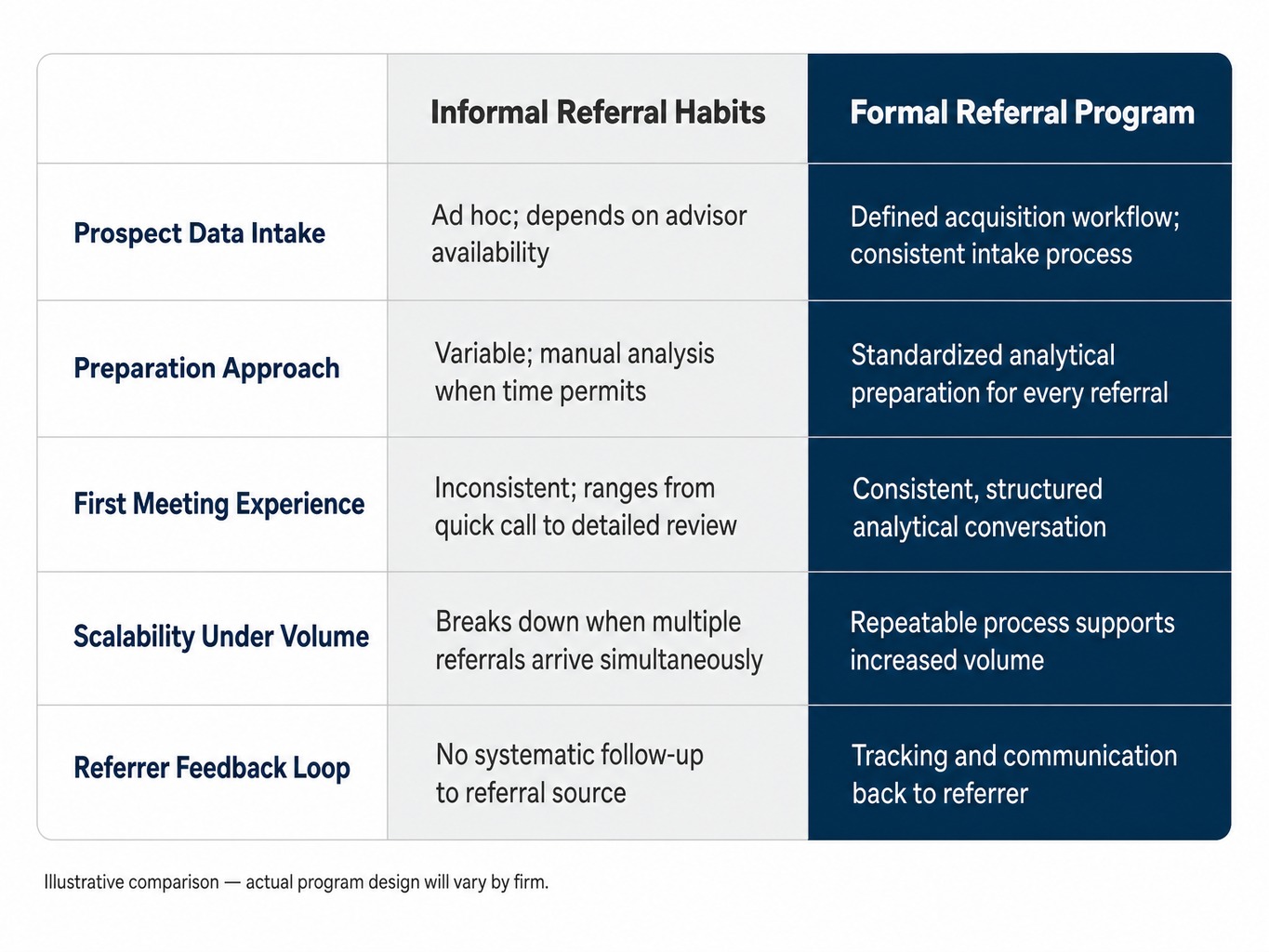
- In one formal model, the firm may use a defined acquisition workflow. Each referral, regardless of source, enters a consistent intake process. The firm may establish internal standards for how follow-up is assigned, when prospect data is requested, how analysis is prepared when appropriate, and what a first analytical conversation should cover.
The choice is not about being corporate for its own sake. It is about selecting an operating model that fits the firm's service approach, team structure, and referral volume. Informal and formal approaches can both be workable, but they tend to offer different tradeoffs around flexibility, consistency, and visibility.
Where Referral Sources Fit Into an Acquisition Workflow
Referral source strategy can be viewed as an input to the firm's acquisition workflow, not just a standalone marketing activity. Different referral sources may introduce prospects with different circumstances and preparation needs. A referral from a CPA connected to a recent business sale may call for a different type of preparation than a referral from a current client introducing an adult child who is earlier in the planning journey.
Centers of Influence and existing clients are two common referral-source categories worth considering. However, viewing them simply as sources of names misses the operational nuance. Each may create different downstream preparation requirements depending on the prospect, the information available, and the stage of the relationship.
Centers of Influence and Preparation Complexity
COI referrals from CPAs, estate attorneys, and insurance professionals can involve a wide range of circumstances. In some cases, these prospects may arrive with multi-custodian holdings, concentrated positions, illiquid assets, or recent liquidity events that require more analytical preparation once information becomes available.
For example, imagine an estate attorney refers a high-net-worth client whose assets are spread across three different custodians.
- If the advisor later receives statements and determines that portfolio analysis is appropriate, the ability to efficiently ingest the held-away asset data , consolidate positions into a single view, and prepare a structured analysis can support the next stage of the engagement.
- If information arrives gradually or preparation is delayed by manual processes, the firm may need more internal coordination before that analysis is ready.
That is why, when portfolio analysis is part of the engagement, firms can benefit from workflows that support efficient data preparation and presentation.
Segmenting Existing Clients by Referral Potential
Some firms may choose to evaluate whether certain client segments are more likely than others to generate introductions. Within a wealth management referral strategy, that can be one optional way to think about where advocacy may be strongest.
This kind of analysis does not need to rely on simplistic proxies. Instead, a firm might review its own historical referral patterns to understand whether particular service experiences, planning milestones, or relationship characteristics appear alongside referral activity.
Consider an illustrative case where a firm reviews its referral patterns over the last two years. The firm might find that clients who recently went through a planning milestone, such as a retirement transition, business succession discussion, or major estate plan update, appeared more frequently in referral conversations during that period. If a firm observed a pattern like that in its own data, it might use the insight to inform future client communication and service planning. This kind of review can help move referral strategy away from a generic, firm-wide ask and toward a more context-specific engagement model.
How Operational Friction Can Affect Referral Follow-Through
Conventional advice on building a referral program often focuses on the relationship layer, such as how to ask, when to ask, and what language to use. That perspective can be useful, but it may leave less attention on the operational layer. Referral follow-through can also be shaped by internal coordination, communication, and preparation workflows after an introduction is made.
Consider an illustrative scenario: a mid-sized RIA tracks referral volume and later reviews how referred prospects moved through the pipeline. The firm finds that some prospects received prompt follow-up and clear next steps, while others experienced delayed outreach, inconsistent communication, or uncertainty around who owned the next action. In a few cases, analytical preparation was also delayed after the advisor determined that portfolio analysis would be useful. In a case like this, a firm may conclude that the challenge is not referral generation alone, but also the processes that support what happens afterward.
Potential operational friction points include:
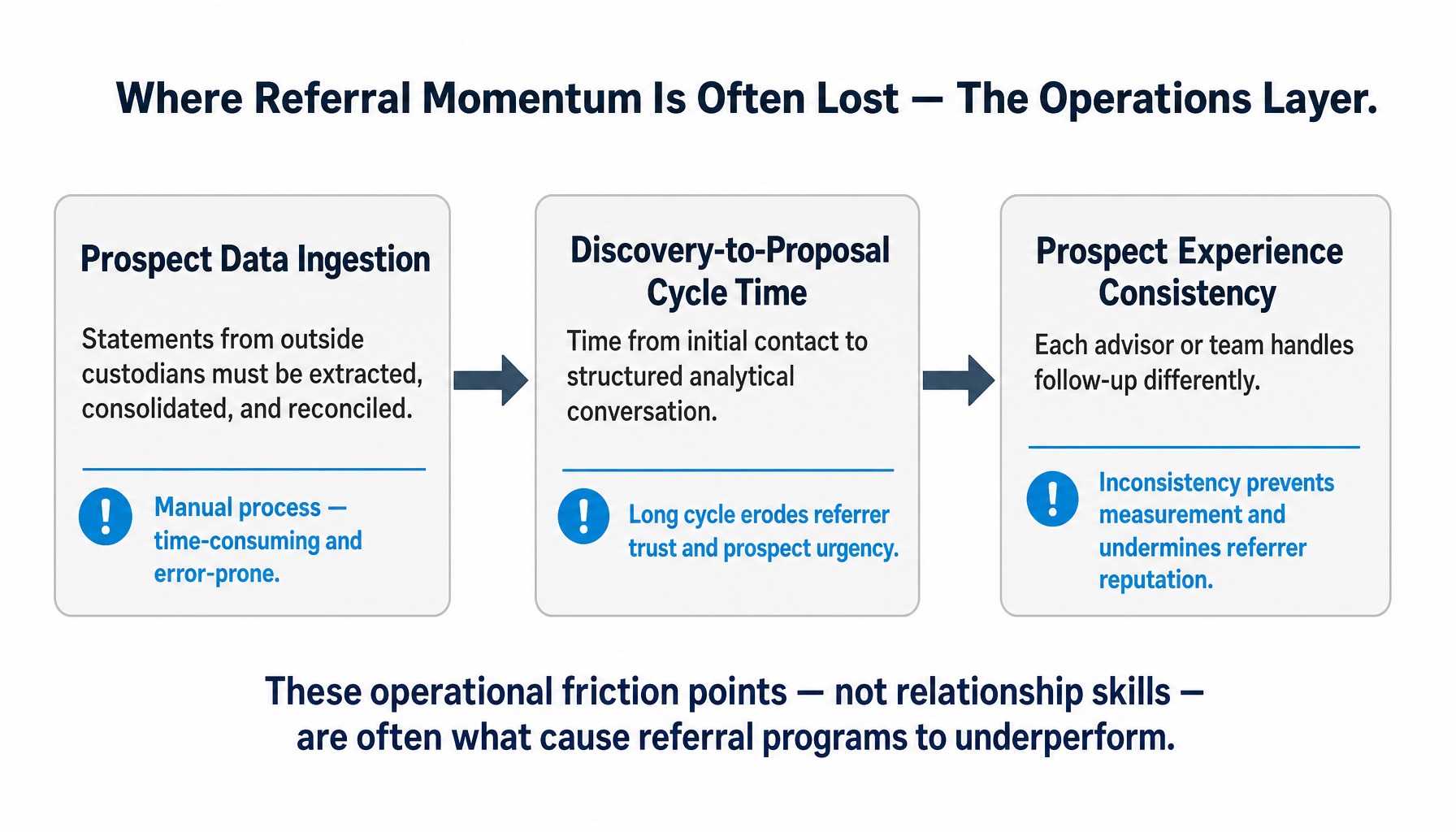
- Prospect Data Ingestion: When a referred prospect shares statements from one or more outside custodians, that data may need to be extracted, consolidated, and reconciled before certain types of portfolio analysis can be prepared. Done manually, this can add time and administrative work to the process.
- Discovery-to-Proposal Cycle Time: This metric reflects how long it takes to move from initial contact to a structured analytical conversation, when that step is appropriate. Reviewing cycle time can help firms identify whether internal delays in scheduling, coordination, or preparation are affecting follow-through.
- Inconsistent Prospect Experience: When each advisor or team handles referral follow-up differently, firms may have less visibility into which processes are working well and where refinements may be needed. Variation can also make it harder to create a shared operational baseline across teams.
These operational hurdles can affect how consistently a promising referral channel is supported after the introduction.
Read more: Operational Visibility for Wealth Management Growth | VRGL
Measuring Referral Program Effectiveness Beyond Referral Counts
Referral counts can be useful, but they do not provide a complete picture of how a referral program is functioning. Counting introductions can show activity at the top of the funnel, while a broader measurement approach can help firms understand how those introductions progress through the acquisition workflow.
One way to deepen that view is to use engagement quality indicators. These metrics focus on what happens after the introduction is made and can help firms investigate where delays, variation, or drop-off may be occurring.
Firms may want to consider metrics such as:
- Referral-to-Client Conversion Rate: What percentage of referred prospects ultimately become clients of the firm? Viewed in context, this ratio can help firms explore questions about prospect fit, timing, communication, and preparation.
- Discovery-to-Proposal Cycle Time: How long does it take, on average, to move from first contact with a referred prospect to presenting a structured analysis or proposal, when that is part of the process? Cycle time, or referral lag time , can serve as a diagnostic tool for reviewing internal delays.
- Referral Channel Mix: Is referral volume concentrated with a single COI or a small group of clients, or is it distributed across multiple sources? Concentration in a small number of referral sources may create risk if those relationships change over time.
Metrics like referral velocity , which tracks how quickly prospects move through pipeline stages, and closed-loop referral reporting , which connects a referral source to the ultimate client outcome, can provide additional operational context. While business outcomes such as net new household acquisition still matter, these measures can help firms evaluate process health and investigate where refinement may be useful.
Compliance Considerations for Referral Incentive Programs
As firms formalize referral practices, the question of incentives often arises. Cash payments, non-cash gifts, and reciprocal arrangements may involve compliance, disclosure, or documentation considerations depending on the firm's structure and the nature of the arrangement.
Rather than prescribing a single approach, firms may want to review a few operational questions with their compliance and legal teams:
- How is the referral arrangement documented internally?
- What disclosures or approvals may be relevant to the firm's process?
- Is there a consistent way to track referral-related activity or incentives if the firm chooses to offer them?
The goal is to treat compliance as part of referral program design, not as an afterthought. Because requirements can vary, firms should consult their own compliance and legal professionals to evaluate how referral practices align with their specific circumstances.
This article is for informational purposes only and does not constitute legal, compliance, or investment advice. Advisory firms should consult with their own compliance and legal professionals to determine how applicable regulations may apply to their specific circumstances.
How VRGL Supports the Referral-to-Proposal Workflow
This article's central argument is that referral outcomes can be influenced by more than the initial introduction alone. One important part of that broader process is the operational workflow that supports follow-through when a prospect relationship reaches the stage where analysis and presentation are appropriate.
The VRGL Growth Platform supports that part of the workflow. It provides a configurable system of work that helps firms standardize analytical preparation within the acquisition workflow.
When a prospect provides statements from one or more custodians, VRGL's automated Statement Extraction can reduce manual statement-entry work by turning unstructured PDFs into structured, analyzable data. From there, an advisor can use the platform's analytics and white-labeled proposal capabilities to move from raw data to a client-ready presentation through a repeatable process. This can support firms that want more consistency and visibility in analytical preparation and reporting activity.
For enterprise firms, CRM platforms typically handle referral-source tracking, follow-up activity, and broader pipeline management. VRGL supports visibility into the analytical and reporting work that follows when portfolio analysis becomes part of the engagement. That can help firms create a more consistent preparation and presentation process without dictating how individual advisors conduct their conversations.
See how VRGL supports your acquisition workflow
Conclusion
A thoughtful financial advisor referral program involves more than generating introductions. It also includes the internal processes that shape how those introductions are handled as prospects move through early engagement, follow-up, and, when appropriate, analytical preparation.
A more structured approach can help firms create clearer intake, ownership, and communication practices. Referral source strategy can also inform what type of preparation may be useful in different situations. And when portfolio analysis becomes part of the process, firms may benefit from workflows that reduce manual preparation and support more consistent presentation.
As referral activity evolves, the gap between receiving an introduction and delivering the next appropriate step can become an operational consideration as much as a relationship one. Firms that evaluate referral follow-through through that lens may be better positioned to support consistency, reduce manual preparation, and adapt as referral volume changes.
Frequently Asked Questions
How do referral programs differ for RIAs versus broker-dealers?
RIAs and broker-dealers may operate under different regulatory frameworks, which can affect how referral practices are documented and reviewed. Because those considerations vary, firms should consult their compliance team to evaluate how their program design aligns with their specific circumstances.
How can multi-office wealth management firms create visibility into referral program activity?
Firmwide referral visibility often depends on consistent tracking across offices, including referral sources, follow-up stages, and conversion outcomes in a shared CRM or similar system. CRM platforms can support pipeline stage attribution for referral activity, while analytical platforms may provide visibility into the reporting and preparation work that follows.
What is a reasonable timeline for evaluating whether a referral program is working?
The right evaluation window can vary based on a firm's sales cycle, client segment, and referral patterns. Rather than applying a fixed timeline, firms may want to review results over a period that reflects how their referred prospects typically move from introduction to engagement.
How can advisors follow up on referrals without losing momentum?
Timely, thoughtful follow-up can help firms respond consistently after an introduction is made. Depending on the situation, that may include prompt outreach, clear ownership of next steps, and a defined process for requesting information or preparing analysis when appropriate.
Can a referral program work without offering financial incentives to referrers?
Yes. Referral practices can take many forms, with or without financial incentives. Whatever approach a firm uses, it can be helpful to review the structure, documentation, and any related disclosures with compliance and legal professionals.